#e4mXplains: Who's really in control? How Meta, Google and Amazon are rewriting the rules of AI advtg
As Meta trims manual placements, Google introduces new budget controls, Amazon offers AI-led campaign buying, advertisers are confronting a changing definition of control. Here's what the changes mean
 by
Published: Oct 20, 2026 9:03 AM | 6 min read
 Follow Us


- Major digital advertising platforms, including Meta, Google, and Amazon, are implementing changes that shift the balance of control from advertisers to algorithms, with a focus on achieving specified marketing goals through automated systems.
- Meta is reducing manual placement options for certain campaign objectives, allowing its AI to make more decisions about ad placements while still offering some customization options for advertisers.
- Google is introducing features that allow advertisers to prioritize channels and set budget allocations, but these controls are described as best-effort limits, meaning actual spending may exceed specified amounts.
- Amazon's new DVA+ offering combines automation with manual controls, allowing advertisers to define objectives while the AI manages various campaign elements, though it remains in beta and is not yet widely available in all regions, including India.
For years, digital advertising has operated on a fairly straightforward bargain. Advertisers provide the money, platforms provide the audience, and both sides negotiate how, where and when an ad appears.
Artificial intelligence is quietly rewriting that arrangement.
Over the past few weeks, Meta, Google and Amazon have introduced or clarified significant changes to their advertising systems, altering how marketers manage placements, budgets and campaign execution.
Read On: New model, who dis? Inside Big Tech’s AI marketing arms race
The announcements appear contradictory. Meta is removing certain manual controls, Google is introducing new ones, and Amazon is promising the convenience of automation without entirely abandoning human intervention.
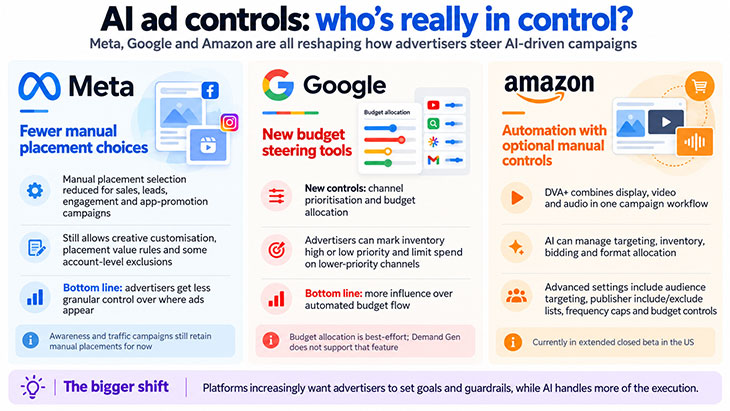
But look closer, and a common principle emerges: platforms increasingly want advertisers to specify what they hope to achieve, while algorithms decide how to achieve it.
So what's actually changing, and who's holding the steering wheel?
Meta: Fewer switches, more automation
Meta has been gradually removing manual placement options from several campaign objectives, with updated guidance published in October explaining the alternatives available to advertisers.
The changes affect campaigns optimised for engagement, leads, app promotion and sales. Advertisers running these campaigns can no longer manually select individual placements at the ad-set level in affected accounts.
Read On: AI can make 100 versions of an ad. Who checks version 63?
Previously, a marketer could exclude particular advertising surfaces, such as Facebook search results or certain placements between Reels. Under the revised system, Meta's AI-powered delivery machinery makes more of those decisions.
Awareness and traffic campaigns continue to retain manual placement options for now.
Meta is not eliminating advertiser control altogether, however. Marketers can customise creative assets for different placements, use placement value rules to increase or decrease bids, and apply certain account-level exclusions by campaign objective.
There is an important distinction here. Reducing a bid for a particular placement is not the same as prohibiting an advertisement from appearing there.
Meta argues that automated placement optimisation can improve efficiency by identifying opportunities advertisers might otherwise overlook.
For marketers, the trade-off is clear: potentially more efficient delivery, but less granular authority over individual placements.
Google: The algorithm gets a budget supervisor
Google, meanwhile, is moving in a somewhat different direction.
On October 14, the company announced two optional features for Google Ads: channel prioritisation and budget allocation.
Read On: Google is giving advertisers more control over ad budgets. But how much?
The first allows advertisers to designate channels as high or low priority. Google's systems then prioritise spending on higher-priority inventory before directing remaining budgets elsewhere.
The second lets marketers specify the maximum proportion of their average daily budget they want allocated to lower-priority channels.
Consider an advertiser spending ₹1 lakh daily. If the Google Display Network is designated low priority with a 10% allocation, Google's systems will aim to limit expenditure on that inventory to ₹10,000.
However, Google describes these allocations as best-effort limits, meaning daily spending can occasionally exceed the specified percentage. A 0% allocation, by contrast, prevents spending on that channel.
The controls are progressively rolling out across Search, Shopping, Performance Max and Demand Gen, although Demand Gen supports prioritisation without the new budget allocation feature.
There are other qualifications.
Within Performance Max and Demand Gen, several Google-owned properties, including YouTube, Search, Gmail and Discover, are grouped together rather than individually prioritised.
Furthermore, prioritisation generally has little effect on campaigns using target-based bidding that are not constrained by budget. Allocation limits remain applicable where supported.
Google is therefore providing advertisers with more ways to influence AI-driven spending, without necessarily returning to granular manual campaign management.
Amazon: Let AI drive, but keep the manual handy
Amazon's approach introduces yet another variation.
Its DVA+ offering, announced on September 29, combines display, video and audio advertising within a single campaign workflow.
Advertisers can define objectives, select products or landing pages, review creative assets and specify budgets. Amazon's AI then manages targeting, inventory selection, bidding, format allocation and optimisation.
But unlike a purely automated system, DVA+ also offers advanced settings for advertisers who want more direct control.
Read On: Beyond Reach: Can AI-generated ads turn attention into action?
These include manual audience targeting, publisher inclusion and exclusion lists, custom bidding, frequency caps and budget allocation across advertising formats.
In other words, marketers can delegate routine decisions to AI while retaining the ability to intervene in more complex campaign strategies.
Amazon also promises domain-level reporting showing where impressions were delivered, including publisher, format and geography.
The distinction matters because automation and transparency are not necessarily the same thing.
There is, however, a geographical caveat. DVA+ remains in extended closed beta in the United States, with broader international expansion planned. It is not yet a generally available product for Indian advertisers.
Amazon's published performance improvements are also based on its own analyses and should not be treated as independently established outcomes.
What does this mean for Indian advertisers?
Taken together, the developments highlight a shift in the division of labour between advertisers and advertising platforms.
Meta is narrowing certain decisions advertisers can make about placements. Google is giving marketers additional influence over how automated systems distribute budgets. Amazon is developing an interface that accommodates both AI-led and manually configured campaign buying.
Read On: Satellite internet is coming to India. Will advertising change with it?
For Indian agencies and brands managing campaigns across platforms, these differences carry practical consequences.
A placement excluded under one system might merely receive a lower bid under another. A budget allocation described as a limit may not function as a guaranteed ceiling. And campaign controls advertised globally might not yet be available in India.
The larger question concerns accountability.
When algorithms increasingly decide which audiences, placements and formats deliver the best results, advertisers must still determine whether those decisions serve their commercial interests.
That makes independent measurement, placement reporting, brand suitability and the quality of conversion data particularly important.
Read On: Are AI platforms building advertising’s next walled gardens?
The platforms' argument is that automation can make advertising more efficient. That is plausible, but efficiency claims must be distinguished from independently verifiable results.
Ultimately, the emerging advertising model is less about advertisers operating every lever and more about setting the rules within which automated systems operate.
The question is no longer simply whether advertisers have control. It is what they can control, how reliably those instructions are followed, and how much visibility they retain when the machine makes the decisions.
The algorithms may be taking the wheel. Advertisers still have to account for where the money goes.
Read more news about Digital Media, Internet Advertising, Marketing News, Television Media, Radio Media
For more updates, be socially connected with us onInstagram, LinkedIn, Twitter, Facebook, YouTube & Google News